Affiliate Marketing for Startups: Complete Guide
Affiliate marketing for startups is an operating system—locks, cost, recruit, rates, tracking, first 100 sales, then diagnose a flat roster.
Affiliate marketers get paid after lock, period close, threshold, and rail withdrawal—Impact, Amazon (~60 days/$10), Rewardful, and Stripe Connect compared.

TL;DR: Affiliate marketers get paid when five clocks clear—sale attribution, lock/hold, period close plus net or brand schedule, minimum threshold, and rail withdrawal—not when the click fires. Impact funds a balance then autopays (from $10); Amazon pays ~60 days after the month ($10 DD/gift); Rewardful tracks but the merchant pays; Stripe Connect can roll funds daily.
“How do affiliate marketers get paid?” sounds like a payment-method question. It is a latency question.
A tracked sale is not a deposit. Between the buyer’s card and your bank sit a hold for refunds, a calendar period, a Net-D or brand schedule, a minimum balance, and a rail that may still wait until Tuesday. Forums get this right in one line: watch the threshold, the cookie, and the locking period together (r/AffiliateMarket).
This page is for sellers. For commission event design, use affiliate commission structures. For tax forms after the money moves, use affiliate marketing tax implications. For Connect plumbing, use Stripe Connect explained for creators.
Affiliate payout is the transfer of approved commission from a program’s ledger into an affiliate’s external account after hold, period, threshold, and rail rules clear.
It is not the cookie window (that is attribution—see affiliate cookie duration and attribution windows). It is not the commission rate (that is economics—see how to negotiate affiliate commission rates). Payout is the cash-ops layer of the same performance contract that starts with a unique ID and ends with an FTC disclosure (how affiliate marketing works).
Timing matters because sellers fund ads and content on calendar cash, and merchants lose partners when “paid” means “sitting in a network wallet.”
Affiliate marketers get paid after a qualifying action clears a hold, joins a pay period, meets a threshold, and exits through a named rail—PayPal, ACH, gift card, check, or a Connect payout to a bank.
Think in a Payout Latency Stack, not a tip list.
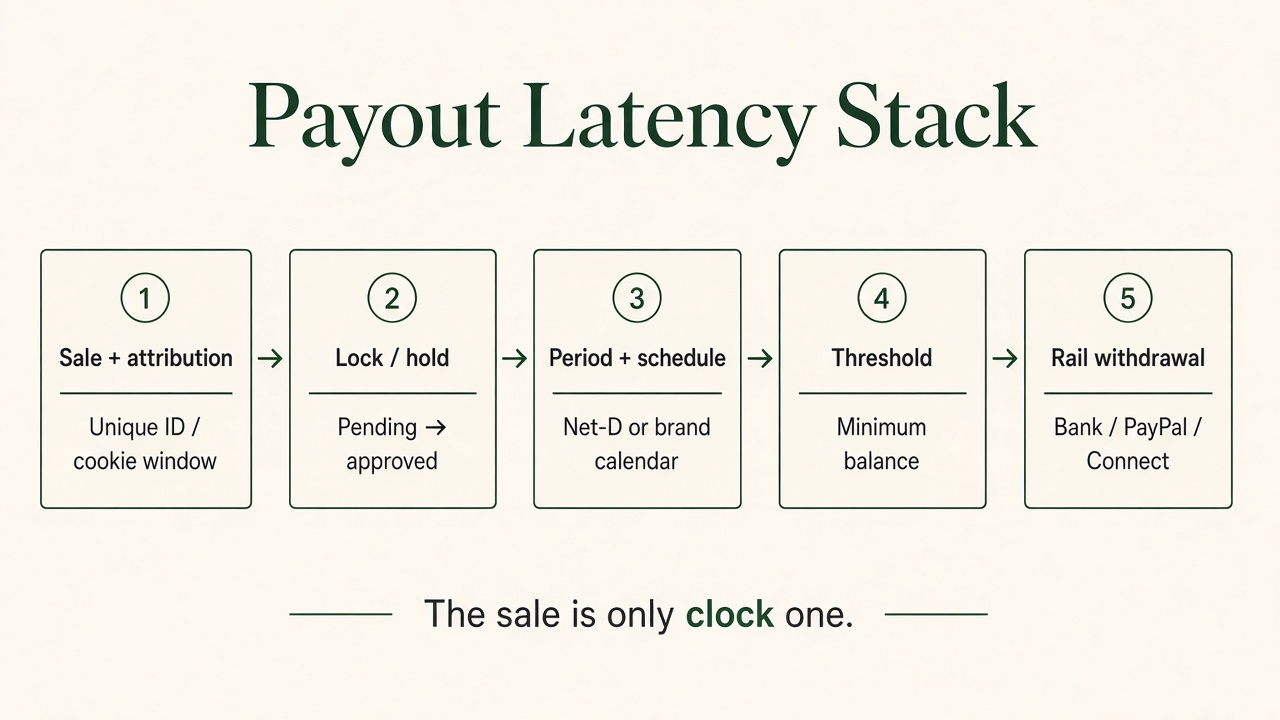
Source: Editorial framework synthesizing Impact Partner Payments lifecycle, Amazon Associates payout help, Rewardful commission states, and Stripe Connect payout docs (accessed 2026-10-07).
The program must attribute a qualifying event to your ID inside the cookie or click window. No attribution, no commission. That clock is owned by tracking rules, not payout ops.
Networks and trackers keep commissions pending through a refund-shaped buffer.
On impact.com, actions move Pending → Locked → Clearing; Locked means the Action Cost is due; Reversed voids it (impact.com Help). After lock, Impact describes an invoicing stretch that can run about 2–3 weeks, then a brand payout-scheduling period, then a brand balance check before money hits your Available Balance.
On Rewardful, commissions stay pending until a due date—30 days by default after the sale, meant to match refund policy—then become due if the affiliate clears any minimum you set (Rewardful Help).
Net-30 (or Net-15 / Net-60) usually means the network pays within D days after the pay period ends—not D days after each sale. affLIFT’s CPA-network explainer walks the classic case: March 1–31 earnings on Net-30 pay on April 30 (affLIFT). That is industry language, not a census that every network uses the same D.
Amazon Associates publishes a hard calendar instead of Net jargon: commission income pays about 60 days after the end of the earning month (January → late March, and so on) (Amazon Associates Help).
Impact lets brands schedule payout relative to lock (date next month, N days after lock, or months+days after lock) inside the contract—so two brands on the same network can feel like different banks (impact.com contracts help).
Approved balance must clear a floor before a withdrawal run includes you.
| Rail | Published minimum (US) | What happens below |
|---|---|---|
| Impact Fixed Day / Balance Threshold floor | USD $10 (threshold option also up to USD $2.5m) | Fixed Day will not withdraw under $10; Balance Threshold waits until your chosen floor (Impact Help) |
| Amazon Associates direct deposit / gift card | $10 | Rolls into next month (Amazon) |
| Amazon Associates check | $100 (Associates can set higher) | Rolls until met (Amazon) |
| Rewardful (merchant programs) | Campaign-set (default often $0 until you raise it) | Stays Pending until due age + threshold (Rewardful) |
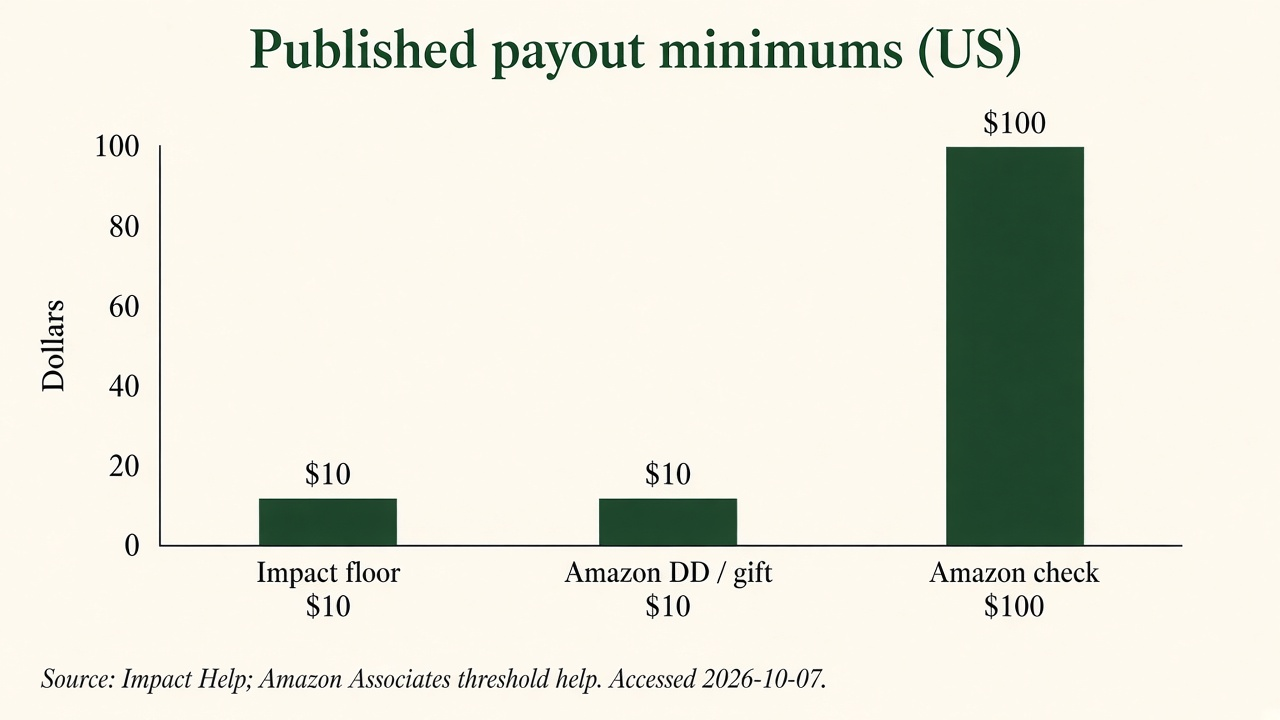
Source: impact.com Partner Payments Help; Amazon Associates Payment Threshold Settings. Accessed 2026-10-07.
Ledger credit is still not a bank deposit.
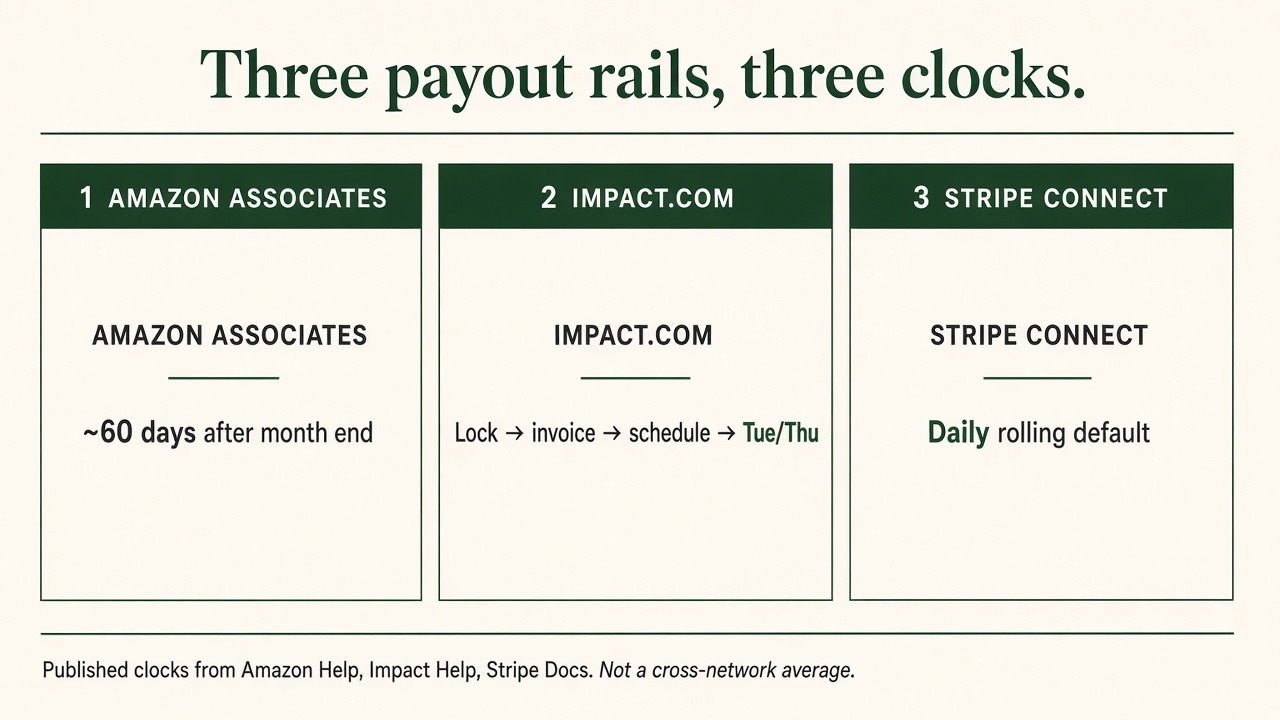
Source: Amazon Associates Help (60-day calendar); impact.com Partner Payments (lock, 2–3 week invoice stretch, Tue/Thu processing); Stripe Connect payout docs (daily rolling default). Accessed 2026-10-07. Bars illustrate published clocks, not a measured median across all programs.
| Job | Typical rail | Who funds the affiliate | Latency pattern |
|---|---|---|---|
| Promote many brands from one dashboard | Partnership network (e.g. Impact) | Brand funds network → Available Balance → autopay | Lock + invoice + schedule + Tue/Thu withdrawal |
| Catalog referrals (retail SKUs) | Amazon Associates | Amazon on published calendar | ~60 days after month + $10/$100 threshold |
| One SaaS product, Stripe billing | Tracker (e.g. Rewardful) | Merchant pays outside the tool | Default 30-day pending + merchant batch |
| Co-branded checkout / marketplace split | Connect-style multiparty | Platform routes at charge time | Often daily rolling / Instant options |
feat. sits in the last row when the job is collaborative selling through a co-branded storefront with an automatic revenue split—not when you need enterprise partner ops or a pure Stripe tracker with no storefront. For how the dollar divides before payout, see revenue split models for collaborative selling. We do not publish feat. payout SLAs or fees here; treat competitor figures above as the public stickers they are.
Q: How do affiliate marketers get paid? A: Through a program ledger that pays approved commissions after a hold, a pay period or brand schedule, a minimum threshold, and a rail withdrawal (PayPal, ACH, gift card, check, or Connect payout). The sale date is only the first clock.
Q: What does Net 30 mean for affiliate payments? A: In common affiliate usage, Net-30 means payment within about 30 days after the pay period closes—not 30 days after each sale. A March sale on a monthly Net-30 cycle often pays at the end of April (affLIFT).
Q: When does Amazon Associates pay? A: Amazon pays commission income about 60 days after the end of the month it was earned, if you meet the minimum and have tax information on file. Direct deposit and gift cards use a $10 minimum; checks use $100 (Amazon Associates Help).
Q: Does Rewardful pay affiliates automatically? A: No. Rewardful tracks commissions and reminds merchants when amounts are due; merchants pay by their own methods (often PayPal or Wise) and mark payouts paid (Rewardful Help).
Q: Is a pending commission the same as money in my bank? A: No. Pending usually means the hold has not finished. Even Locked or Due amounts still need period rules, thresholds, brand funding, and rail processing before a deposit appears.
Affiliate marketers get paid when the Payout Latency Stack clears—not when a dashboard flashes a new sale. Read lock, period, threshold, and rail as one system, and pick Impact-style funded networks, Amazon’s catalog calendar, merchant-paid trackers, or Connect splits for the job you actually have.
If you want to sell products through a co-branded storefront with an automatic revenue split instead of waiting on a merchant’s monthly PayPal CSV, browse offers on the feat. marketplace.
Affiliate marketing for startups is an operating system—locks, cost, recruit, rates, tracking, first 100 sales, then diagnose a flat roster.
How to track affiliate sales: pick link cookie, coupon, pixel, S2S postback, or storefront checkout—then match Rewardful, Tapfiliate, or Impact.
Best affiliate programs for SaaS companies pass the Recurring Cap Test: labeled duration, cookie, seat type, payout rails—plus Rewardful’s ~24% planning band.