How to Build a Commission-Based Sales Network
Build a commission-based sales network as a single-tier seller graph—economics, surface, named sellers, then density. Rewardful: only 1.28% of affiliates sell.
Turn customers into a sales channel via referral, affiliate, or a co-branded storefront. ReferralCandy’s rate is 2.35%; only 1.28% of affiliates sell.

TL;DR: How to turn your customers into a sales channel is a contract choice, not a thank-you-page widget. The same buyer can sit on a double-sided referral reward, an affiliate commission, or a co-branded storefront of your existing offer. Plan referral volume around ReferralCandy’s 2.35% rate. Do not forecast affiliate sales from roster size: Rewardful finds only 1.28% of affiliates ever sell.
Most merchants already have a sales channel sitting in the order list. They ignore it, then pay strangers to say the same sentence a happy buyer would say for free. That is why how to turn your customers into a sales channel keeps getting answered with “add an affiliate invite on the thank-you page,” which is a signup trick, not a contract.
Shopify treats referral and affiliate as different identities: the referrer is usually a current customer; the affiliate is a publisher with an audience (Shopify). Ranking pages still mash those jobs together. ReferralCandy’s established-program average is 2.35% of purchases referred (~1 in 50 sales). Software and digital goods print 4.75% (ReferralCandy). Rewardful’s SaaS sample (n=2,847) finds 7.6% of affiliates generate a referral and 1.28% generate a sale (Rewardful). Those are different meters. One widget cannot own both.
Key takeaways:
Turning customers into a sales channel is the practice of giving people who already bought a named contract — referral, affiliate, or co-branded storefront — so they can send the next buyer with tracked attribution and a payout that matches the job.
It is not “word of mouth, but with a coupon.” Word of mouth is unmetered friendship. A channel has a surface, a qualifying event, and a settlement. ReferralCandy’s definition is the one to steal for the friendship job: referral rate is referred purchases as a percentage of total purchases, and the global average after about six months of data is 2.35% (ReferralCandy). That is a volume share of your own checkout, not an affiliate conversion rate.
It is also not a cold affiliate recruiting motion with a friendlier subject line. Cold affiliates never bought. Customers already paid. Shopify’s 2026 split is useful here: referrals tap a personal network; affiliates tap reach (Shopify). When a repeat buyer also has an audience, you still pick a contract. You do not auto-upgrade every five-star review into a lifetime 30% CPS seat.
feat. sits on the third rail: one listing, many storefronts. Approval forks a co-branded page with the customer’s handle, your locked offer, and an automatic split on attributed checkout. Marketplace listing is optional. feat. does not find the customers for you. If you cannot name the first ten buyers you would trust with a page, you do not have a channel yet. You have a hope.
A paid buyer is the only promoter who has already survived your product. Strangers can still sell. They start from a worse prior. The Performance Marketing Association’s 2025 study put 2024 U.S. affiliate spend at $13.62B, generating $113B in e-commerce sales (9.4% of U.S. e-commerce) (PMA). That money is real. It is mostly not your customers unless you give them a contract.
Why the channel beats another cold roster:
Vendor blogs will quote 3–5× conversion on customer-to-affiliate invites versus cold outreach. Those figures are not a public census. Do not chart them. Chart the contracts you can name.
The Buyer-to-Seller Contract Ladder is three contracts for the person who already paid: a double-sided referral reward for friends, an affiliate commission for audience-led selling, and a co-branded storefront when they need a page, not a parameter. Pick one contract per person. Mix the meters and you will report a “channel” that is really three half-built programs.
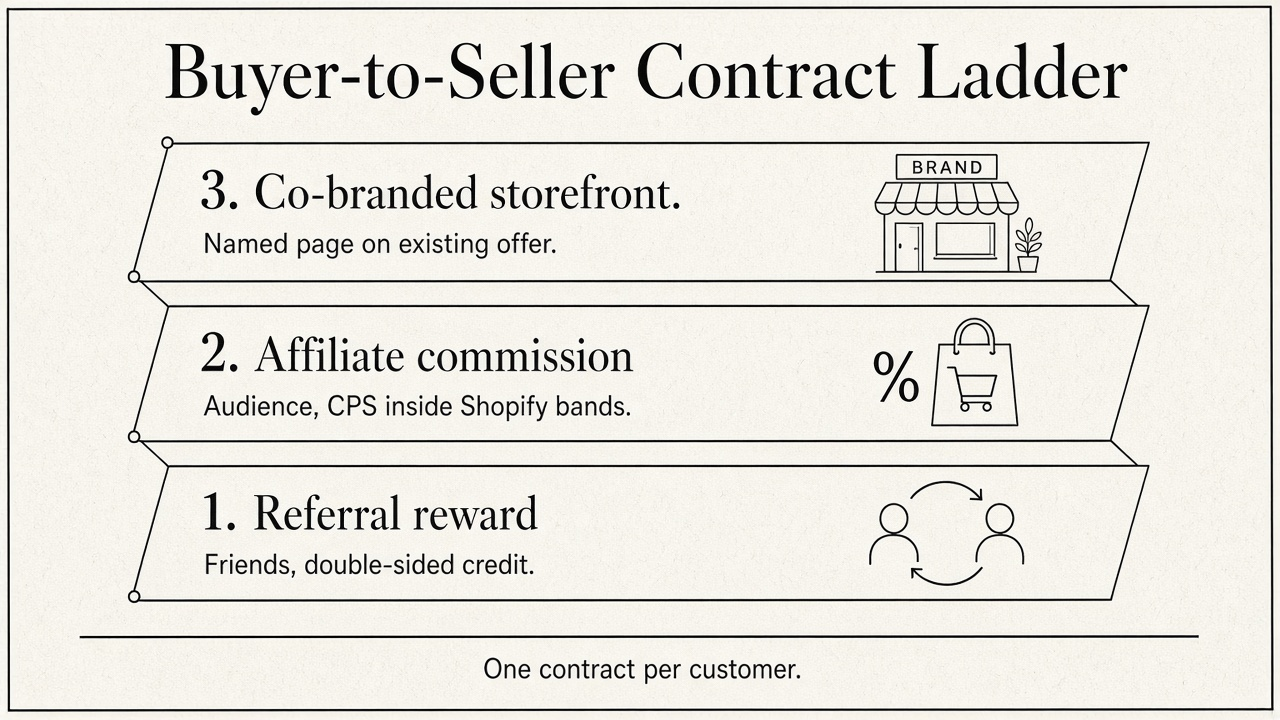
Source: Editorial framework synthesized for this article from ReferralCandy, Rewardful, Shopify, and feat. product mechanics. Taxonomy diagram, no invented conversion rates.
Referral is identity-first. The promoter is your customer. The buyer is usually someone they actually know. The reward is often double-sided: credit, a month free, or a discount for both sides (Shopify; ReferralCandy). The scoreboard is referral rate, not EPC.
| Meter | What it counts | 2026 published figure | Source |
|---|---|---|---|
| Referral rate | Referred purchases ÷ total purchases | 2.35% global; 4.75% software/digital | ReferralCandy, 6+ months of program data |
| Share-action rate | Share clicks ÷ eligible prompt views | 4.64% top quartile; 13.38% top 10% | ReferralCandy 2026 Shopify study, n=500 |
| Order/revenue contribution | Referred orders or revenue vs typical | ~2.5× upper quarter; ~6× top 10% | Same 2026 study |
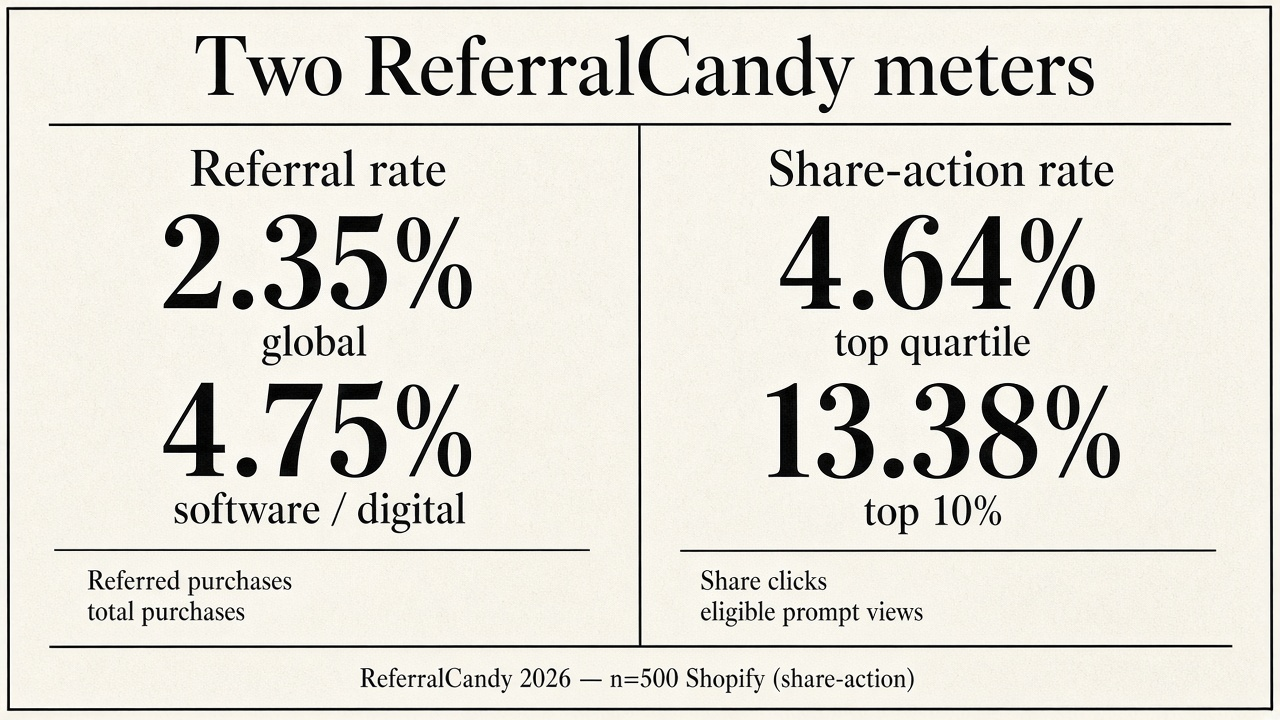
Source: ReferralCandy, What’s A Good Referral Rate in 2026; State of ecommerce referral programs 2026 (n=500 Shopify stores, Jul 2025–Jun 2026). https://www.referralcandy.com/blog/referral-rates/ · https://www.referralcandy.com/blog/referral-program-benchmarks-whats-a-good-conversion-rate-in-2025/
If the job is “ask happy buyers to tell a friend,” this is the contract. It is the job referral program benchmarks already own. Do not pay that person a 24% SaaS-style commission because a blog said customers convert better. Rewardful’s 24.16% average is an affiliate statistic, not a referral reward (Rewardful).
Affiliate is performance-first. The promoter may still be a customer, but the job is content, not a text to a roommate. Shopify’s published bands still bound the envelope: physical 5%–15%, digital 20%–50%, subscriptions 15%–30% recurring (Shopify). Rewardful’s activation funnel is the constraint: 7.6% refer, 1.28% sell, 16.8% of those who refer convert a sale (Rewardful).
A thank-you-page “become an affiliate” checkbox is how you recreate Rewardful’s graveyard: lots of joins, almost no sales. Screen on a second purchase, a review, or a named distribution surface. PartnerStack’s 43% vs 3% Network gap is a quality filter, not a feat. claim (PartnerStack). Open signup on every customer is the 3% path with extra email volume.
There is no public dataset that a customer-affiliate converts at 3–5× a cold affiliate. AdsX, Matt McWilliams, and Reddit threads repeat that band. Leave it off the chart. Use Rewardful and PartnerStack, which name a sample.
A unique link without a page still dumps the friend onto your generic PDP. That is a tracking parameter. A seller needs a surface. How to turn anyone into a seller names the rails: seat, surface, signal, settlement. Customers are the warmest seat you have. feat. forks the storefront on approval: their handle, your brand kit, your locked SKU, attributed checkout, automatic split. You still own price, fulfillment, and refunds.
This is the contract when the customer will actually post, DM a group, or run a small list — and you want the buyer to land on a collaboration page, not a coupon field. It is not Stan Store for their own PDFs. It is not Impact’s partnership cloud. Impact still wins when you need enterprise partner ops, fraud tooling, and a 90,000-partner marketplace. feat. wins when the job is distribution of an existing product through people you can name. Live feat. percentages appear in-product. Do not invent a public fee sheet.
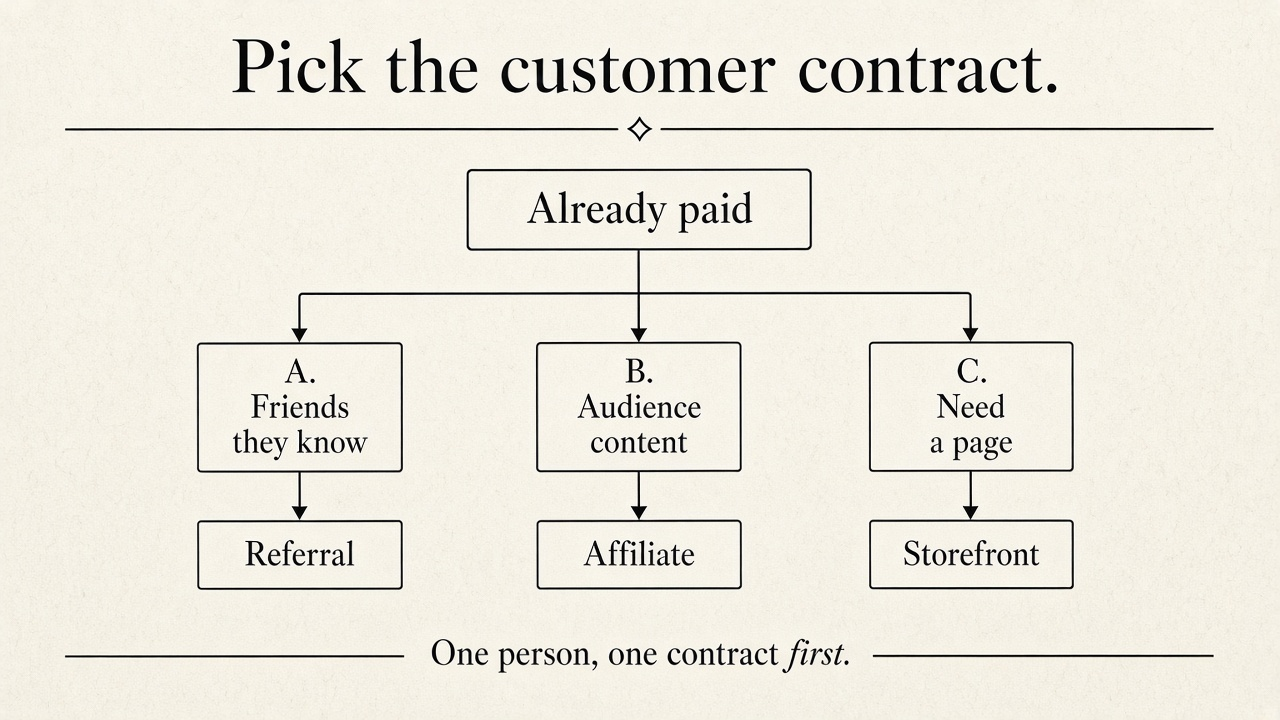
Source: Editorial decision flow synthesized from Shopify’s referral-vs-affiliate identity split, ReferralCandy meters, Rewardful activation, and feat. storefront mechanics. https://www.shopify.com/blog/referral-vs-affiliate-marketing
| Job | Contract | Typical payout shape | Scoreboard | When it wins | When it loses |
|---|---|---|---|---|---|
| Tell a friend | Referral program (ReferralCandy, Friendbuy, in-app widget) | Double-sided credit or discount | Referral rate (~2.35% planning baseline) | Personal network, high NPS, repeat AOV | They have an audience, not a friends list |
| Publish to an audience | Affiliate CPS (Rewardful, Tapfiliate, Impact) | % of sale inside Shopify bands | Referrals and sales, not joins (1.28% sell) | They already make content in your category | You auto-enroll every checkout |
| Share a collab page | Co-branded storefront (feat.) | Revenue split on attributed checkout | Attributed storefront revenue | Named customers you will approve; existing offer | You need enterprise partner ops or a catalog network |
Keep the three programs in three dashboards. KickoffLabs’ one-liner still holds: referral uses customers to bring customers; affiliate pays third parties for traffic (KickoffLabs). The storefront is the missing third sentence: a customer who will sell needs a page, not only a code.
These six steps install a customer sales channel without dumping every buyer into one affiliate roster. Each step is at most two sentences.
There is no public dataset for time-to-first-sale after a customer storefront fork across verticals. Promise a page in minutes after approval, which is the product path. Do not promise a payout calendar you have not configured.
Q: How do you turn customers into a sales channel without hiring salespeople? A: Give each paying customer one contract: a referral reward for friends, an affiliate commission for audience-led selling, or a co-branded storefront of your existing offer. Mixing those three into one thank-you-page invite is how the channel looks busy and stays flat.
Q: Is turning customers into affiliates the same as a referral program? A: No. A referral program rewards a current customer for a friend-led purchase, usually with double-sided credit. An affiliate program pays a performance commission for tracked sales, often to someone with an audience. Shopify’s identity split is the clean test; keep separate terms and dashboards.
Q: What referral rate should I plan for when customers share? A: On ReferralCandy’s definition, plan around 2.35% of purchases referred after about six months, or 4.75% if you sell software or digital goods. Share-action is a different meter: top-quartile Shopify programs in the 2026 study hit 4.64% of eligible prompt views.
Q: Do customer-affiliates convert better than cold affiliates? A: They should, because they already bought, but there is no public census for a 3–5× lift. Use Rewardful’s 1.28% sale-activation floor as the affiliate constraint, and PartnerStack’s 43% vs 3% Network gap as the quality filter, then measure your own cohort.
Q: When does a customer need a storefront instead of a code? A: When they will post, DM a group, or run a list, and the next buyer should land on a collaboration page rather than your generic PDP. A code is enough for a text to a friend. A storefront is the sell surface; feat. forks it on approval and does not recruit the customer for you.
How to turn your customers into a sales channel is a ladder, not a widget. Friendship gets a double-sided referral and a 2.35% planning rate. Audience selling gets a commission inside Shopify’s bands and a 1.28% activation reality check. The customers you would actually trust with a page get a co-branded storefront, attribution, and an automatic split. List the offer on feat. if you already know which buyers should sell it for you.
Build a commission-based sales network as a single-tier seller graph—economics, surface, named sellers, then density. Rewardful: only 1.28% of affiliates sell.
Revenue split models for collaborative selling: Rewardful SaaS avg is 24.16%; only 1.28% of affiliates sell. Split the dollar, then activate partners.
Affiliate marketing for startups is an operating system—locks, cost, recruit, rates, tracking, first 100 sales, then diagnose a flat roster.