Email Preference Center Best Practices
Preference center best practices: CAN-SPAM menu plus stop-all, Google one-click vs body preference pages, and SendGrid's labeled 20% unsub drop.
Newsletter makegood policies: delivery vs performance, Paved CTR and bot thresholds, IAB credit rules, and how to write the remedy before send.

TL;DR: Newsletter makegood and underdelivery policies decide when you owe a free rerun, credit, or refund after a send. Separate delivery failure from performance shortfall. Paved publishes CTR of 1% or less and bot clicks of 50% or more as network triggers. IAB ties makegoods to guaranteed deliverables, not CPC or CPA. There is no public census of how often newsletters issue makegoods. Not legal advice.
The dispute email always arrives after the issue has already left. The sponsor wants a free second send because clicks looked soft. You want to keep the relationship without turning every soft CTR into unpaid inventory. That fight is what newsletter makegood and underdelivery policies are for.
The full cluster map lives in the email marketing guide.
Pair this page with newsletter insertion order explained, newsletter sponsorship kill fees, how to invoice newsletter sponsors, newsletter ad CTR and CPC planning benchmarks, and Paved vs beehiiv ad network.
A newsletter makegood is a free adjustment, credit, or agreed remake when the publisher failed to deliver the booked placement as written, or when both sides agreed in advance that a named performance floor would trigger a remedy. It is the after-send cousin of a kill fee, and it only works if the insertion order already named the trigger.
Underdelivery is the narrower sibling: you promised a send to a dated list, a placement, or another guaranteed deliverable, and you missed it. Wrong creative, wrong section, broken link on your side, or a send that never went out are underdelivery problems. Soft conversion on the advertiser’s landing page is usually not.
Paved defines a makegood as a free adjustment or credit when a sponsorship has a significant performance issue, and lists both delivery failures (placement, graphics) and performance thresholds (CTR, bot share) as triggers on its network (Paved help; Paved blog, August 25, 2022). InfluencersKit’s contract guidance pushes the opposite instinct for direct deals: tie any makegood to delivery failure, quote historical ranges as historical, and do not guarantee clicks (InfluencersKit). Both can be true in the same industry if you name which rule set you are using.
Kill fees price cancel before send. Makegoods price remedy after send. Put both in the same insertion order.
Clear newsletter makegood and underdelivery policies matter because email inventory is irreversible. Once the issue sends, you cannot pull the placement back into inventory the way a display network can pause a line item. Without a written fork, every post-send complaint becomes a negotiation you already lost on leverage.
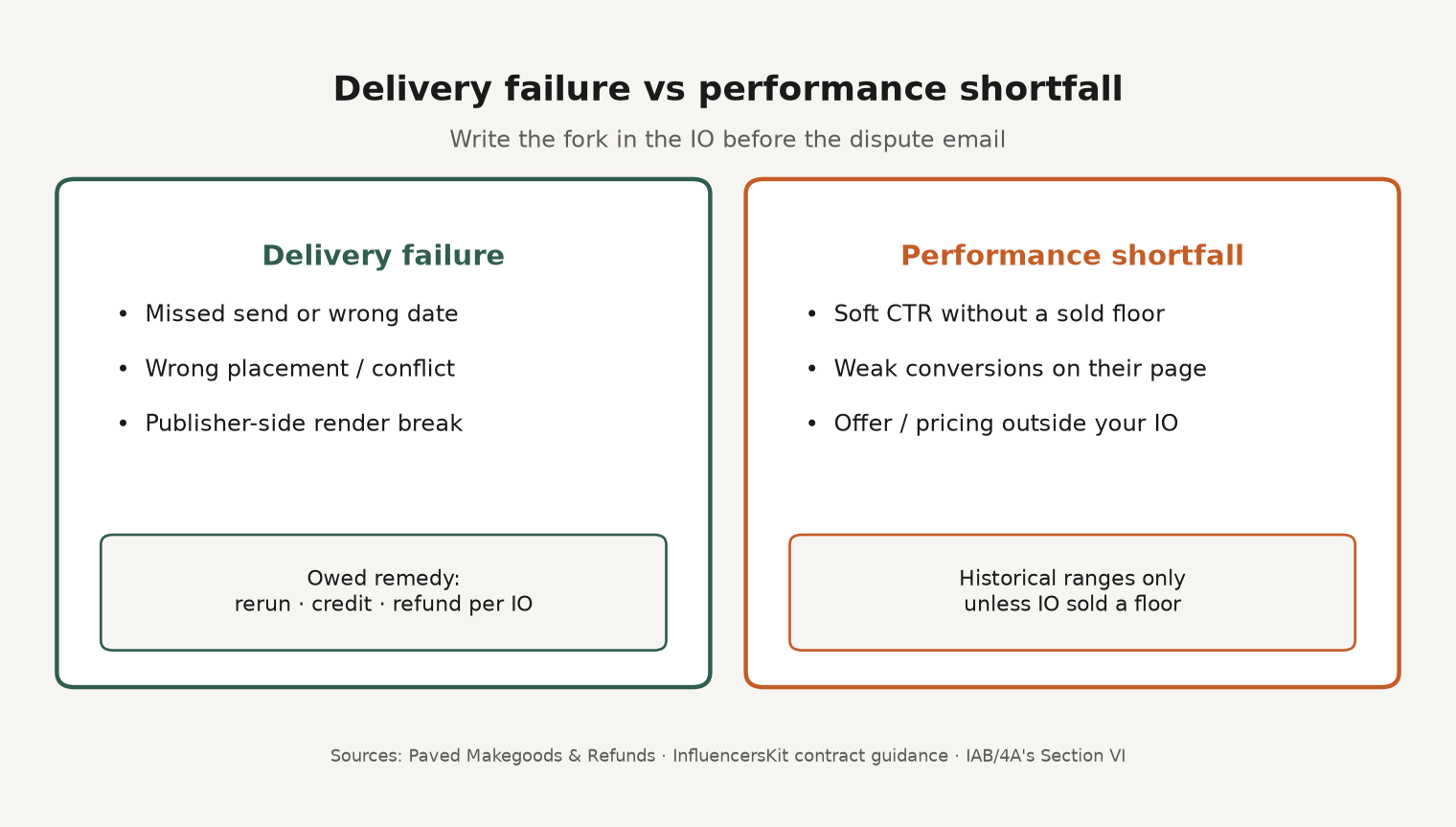
Source: Synthesis of Paved Makegoods & Refunds (https://www.paved.com/help/articles/8121038-makegoods-refunds), InfluencersKit contract guidance (https://www.influencerskit.com/blog/newsletter-sponsorship-contract-getting-paid), and IAB/4A’s Standard Terms Section VI (https://iab.com/wp-content/uploads/2015/06/IAB_4As-tsandcs-FINAL.pdf). Accessed 2026-09-27.
Newsletter makegood and underdelivery policies work by naming three things before the send: what counts as delivery, whether any performance floor exists, and which remedy (rerun, credit, or refund) applies when a trigger fires. After send, you measure against that document, not against the sponsor’s mood.
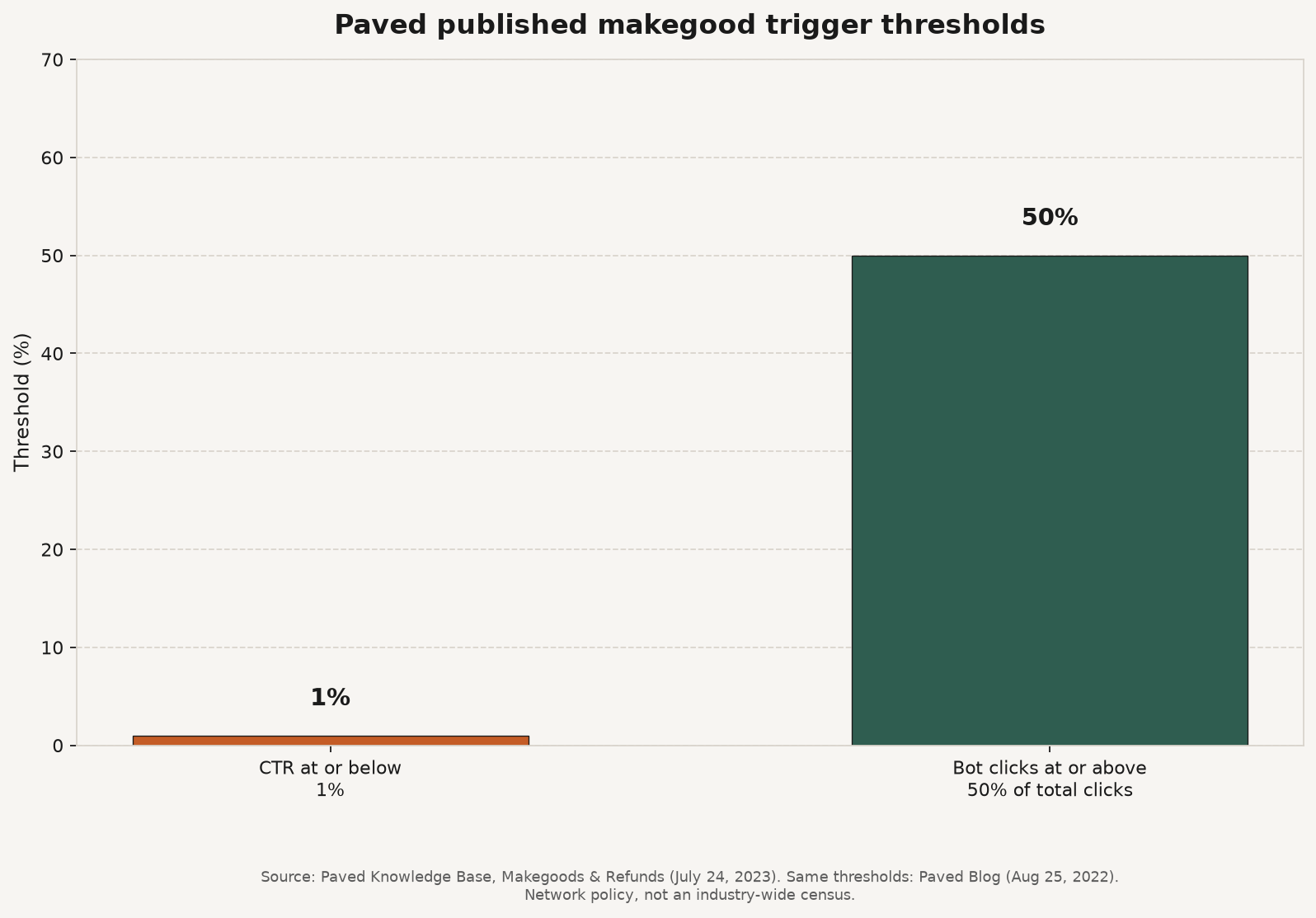
Source: Paved Knowledge Base, Makegoods & Refunds (July 24, 2023), https://www.paved.com/help/articles/8121038-makegoods-refunds. Same thresholds appear in Paved Blog (August 25, 2022), https://www.paved.com/blog/email-ad-makegoods/.
| Situation | Usually owns the risk | Typical remedy when policy is clear | Notes |
|---|---|---|---|
| Send never went out / wrong date | Publisher | Full refund or free reschedule | Pure underdelivery |
| Ad in wrong section or next to conflicting material | Publisher | Free rerun or credit | Paved lists this as a makegood trigger (Paved) |
| Graphics/display broken on publisher side | Publisher | Free rerun or credit | Exclude advertiser-supplied assets that failed specs |
| CTR at or below 1% (Paved network) | Shared by network policy | Makegood / alternate offer | Paved threshold, not a universal law (Paved) |
| Bot clicks 50%+ of clicks (Paved network) | Publisher / list hygiene | Makegood entitled under Paved rules | Treat as list-quality failure on that network |
| Clicks fine, conversions weak | Advertiser | No automatic makegood | Landing page and offer sit outside your deliverable |
| CPC / CPA IO under IAB terms | Advertiser (unguaranteed) | Makegoods not available under IAB VI© | Guaranteed delivery language does not apply (IAB PDF) |
Paved’s help center and blog list four request situations: unusually low engagement (CTR of 1% or less), high bot clicks (50% or more of total clicks), placement issues, and display or graphics problems not caused by the advertiser (Paved help). The resolution path is advertiser request, publisher notification, alternate offer (often another placement or channel), then a coordinated rerun. Cash refunds are not the default: “As a company policy, we do not issue refunds,” with makegoods and ad credits facilitated instead (Paved).
That is a marketplace operating manual. It is useful evidence for what sophisticated buyers already expect. It is not proof that every direct-sold newsletter must guarantee a 1% CTR. For planning ranges on CPC and CPM, use the CTR and CPC planning spoke. For network fee structure, use Paved vs beehiiv.
IAB/4A’s Standard Terms Section VI is written for internet media buys, not specifically for creator newsletters, but agency buyers still reach for it. Media companies must monitor delivery and notify of probable under-delivery as soon as possible, and no later than 14 days before the IO end date when the campaign is at least that long (IAB PDF). If actual Deliverables fall below guaranteed levels, or an Ad is omitted, the parties use commercially reasonable efforts to agree a makegood flight. If they cannot agree, the agency may take a credit for the under-delivered portion. Prepaid advertisers who are otherwise current may elect a refund for the undelivered value. Section VI© states that CPA, CPL, and CPC Deliverables do not get guaranteed delivery, even delivery, or makegoods (IAB PDF).
Your flat-fee primary sponsorship is closer to a fixed placement than to open CPC. Say so on the IO. Do not accidentally import CPC makegood language into a flat booking, or flat guarantees into a CPC test.
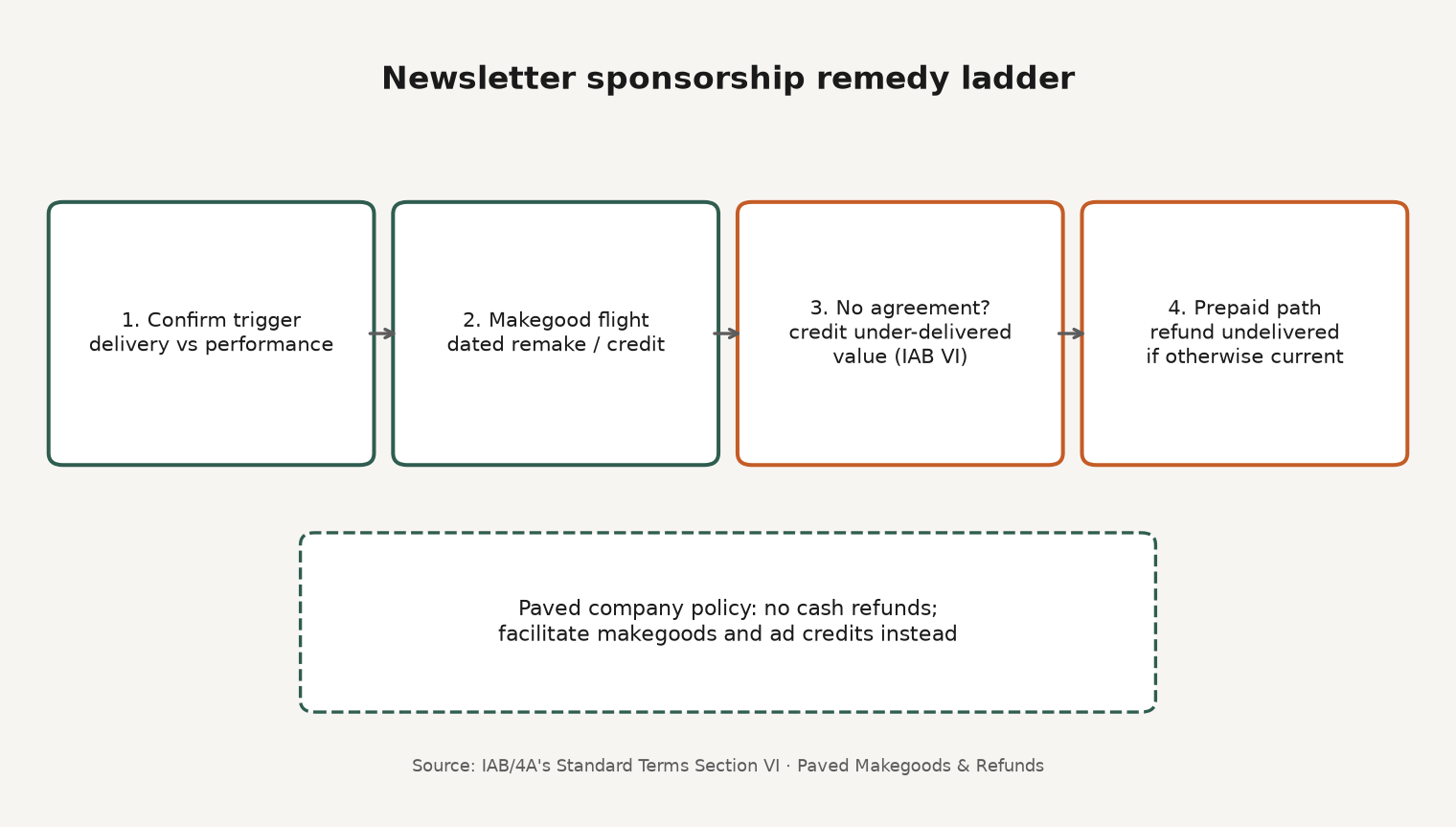
Source: IAB/4A’s Standard Terms Section VI (https://iab.com/wp-content/uploads/2015/06/IAB_4As-tsandcs-FINAL.pdf); Paved refund policy note (https://www.paved.com/help/articles/8121038-makegoods-refunds). Accessed 2026-09-27.
On r/Newsletters, operators already talk about packaging “a make-good if opens miss” when selling on guaranteed opens versus subscriber count (thread). Adjacent creator threads on YouTube sponsorships debate free second placements when views miss, which is the same emotional script with a different inventory shape. Treat that language as demand evidence. Do not treat forum consensus as a rate card.
Write the policy into the insertion order before creative is due, while you still have leverage and a clear head. Name delivery, any performance floor, and the remedy order in plain language a media buyer can quote. Each step below is at most two sentences. Not legal advice. Have counsel review anything you treat as binding.
Q: What is a newsletter sponsorship makegood? A: A makegood is a free adjustment, credit, or agreed remake when the booked sponsorship had a significant delivery or (if contracted) performance problem. Paved defines it as a free adjustment or credit for a significant performance issue (Paved). Your IO should say which problems qualify.
Q: Does a low CTR automatically entitle a sponsor to a free newsletter send? A: Not unless your contract or network rules say so. On Paved, CTR of 1% or less is a published situation where an advertiser may request a makegood (Paved). Direct deals that quote historical ranges without a floor usually treat soft CTR as non-guaranteed.
Q: What does underdelivery mean for newsletter ads? A: Underdelivery means you failed to deliver a guaranteed piece of the IO: the send, the placement, the list size you promised, or the creative unit as booked. IAB Section VI centers makegoods on deliverables below guaranteed levels or omitted Ads, not on the advertiser’s conversion rate (IAB PDF).
Q: Are makegoods available on CPC or CPA newsletter deals under IAB terms? A: Under IAB/4A’s Section VI©, CPA, CPL, and CPC Deliverables do not get guaranteed delivery, even delivery, or makegoods (IAB PDF). If you sell CPC newsletter inventory, do not imply a free remake when CPC is soft unless your own IO overrides that frame.
Q: Should I offer cash refunds or free reruns for newsletter sponsorship problems? A: Prefer a dated remake or credit when the placement ran but something material failed, and reserve cash refunds for clear non-delivery or prepaid undelivered value. Paved’s published company policy routes to makegoods and credits rather than cash refunds (Paved). Write your order of remedies before the dispute.
Makegoods are a written fork between “we missed the deliverable” and “their offer did not convert,” backed by the floors you actually sold. Use Paved’s dated thresholds as one marketplace’s rules, use IAB Section VI when agencies ask for under-delivery language, and refuse invented averages for how often free sends happen.
If you want distribution that does not depend on a single sponsorship slot going perfectly, list a product affiliates can sell through co-branded storefronts on feat..
Preference center best practices: CAN-SPAM menu plus stop-all, Google one-click vs body preference pages, and SendGrid's labeled 20% unsub drop.
Mailchimp vs Klaviyo: contact billing fork, send multipliers (10x/12x/15x), starting prices, and when ecommerce depth beats a general ESP.
Email list growth benchmarks: Omnisend 1.24B popup displays at 2.1%, form-type ladder, and levers that beat the average without inventing MoM %s.