Email Preference Center Best Practices
Preference center best practices: CAN-SPAM menu plus stop-all, Google one-click vs body preference pages, and SendGrid's labeled 20% unsub drop.
Newsletter sponsorship kill fee explained with published cancel ladders from React Weekly, GRC Engineer, and Morning Brew, plus how to write your window.

TL;DR: A newsletter sponsorship kill fee is what the advertiser still owes when they cancel after you held inventory. There is no official public average percentage. Publish a ladder you will enforce, then put it in the insertion order. Not legal advice.
Sponsors cancel. Lists do not refill themselves on Tuesday morning. If your only answer is “we’ll figure it out,” you already paid for the empty slot with the brand you turned away last week. A newsletter sponsorship kill fee prices that opportunity cost in writing before the inventory goes cold.
The full cluster map lives in the email marketing guide.
Pair this page with newsletter insertion order explained, how to build a newsletter media kit, newsletter sponsorship rates by subscriber count, dedicated email sponsorship pricing, and Paved vs beehiiv ad network.
A newsletter sponsorship kill fee is the amount an advertiser still owes (or the refund share they forfeit) when they cancel a confirmed booking after the publisher held a dated slot. It is opportunity-cost pricing for inventory that may not resell in time.
Kill fees sit next to cancellation windows, deposits, and non-cancellable SKUs. CrossLetter’s planning language is a full-payment window inside about a week of send, with partial payment or rebooking outside that window (CrossLetter). InfluencersKit describes a kill fee as a percentage scaled by notice, and treats a 50% deposit as a normal ask for new advertisers (InfluencersKit). Neither source is a census of every newsletter.
Agencies still recognize IAB-style cancel notice by deliverable type. Your weekly primary is closer to a fixed placement than to open CPM inventory. Write the fee in the same IO that names placement and price from your rate card.
Kill fees matter because sponsorship inventory is dated. When Brand A books your Thursday primary, Brand B hears “sold out.” If Brand A walks on Wednesday, the empty cell is your loss unless the cancel policy already priced that held slot.
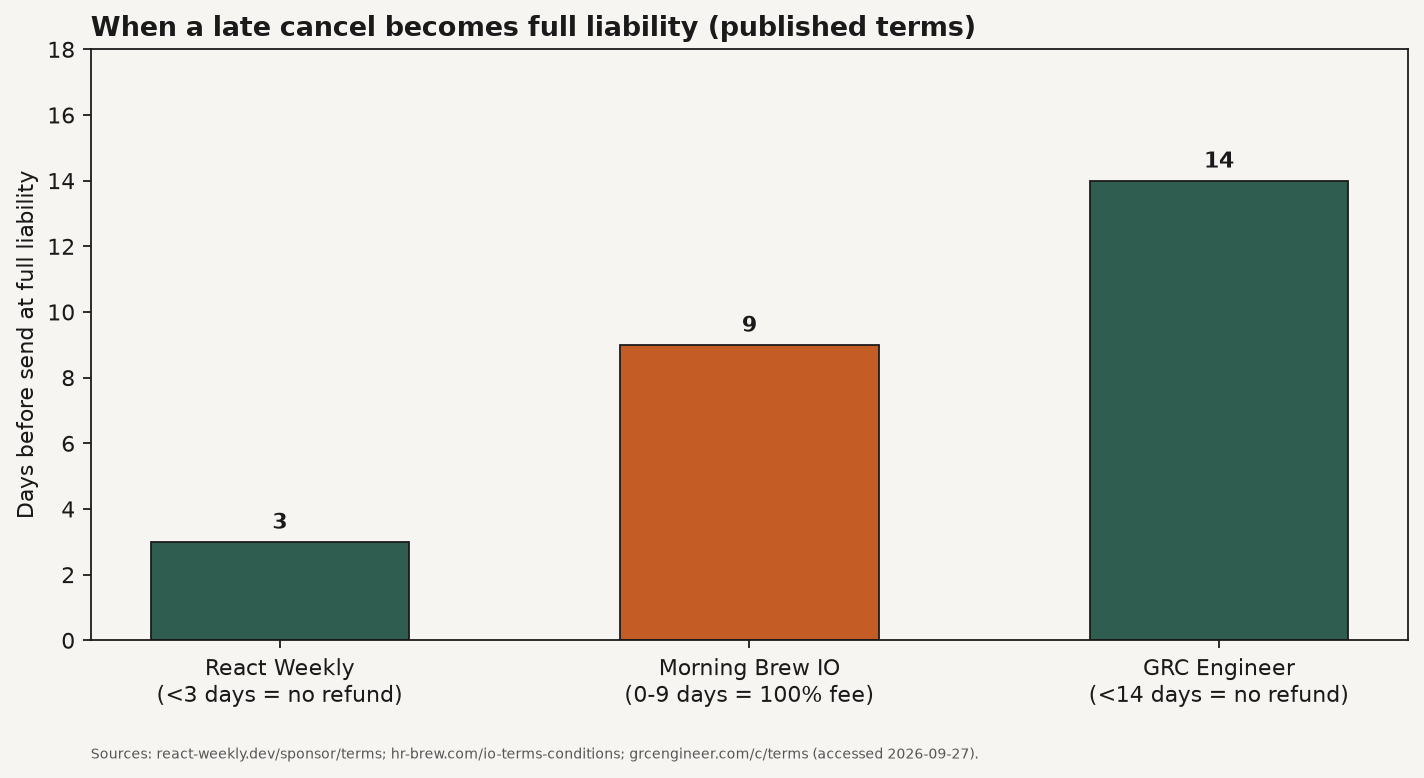
Source: React Weekly Sponsorship Terms (Jun 24, 2026); GRC Engineer Refund & Cancellation Policy (Feb 2026); HR Brew IO Terms (accessed 2026-09-27). URLs in caption under the comparison table below.
Kill fees work as a published ladder tied to days before send. Near the issue, the sponsor keeps more liability. Farther out, refunds or cheap reschedules are easier. Compare named policies, then pick a ladder that matches your send cadence and how fast you can resell a slot.
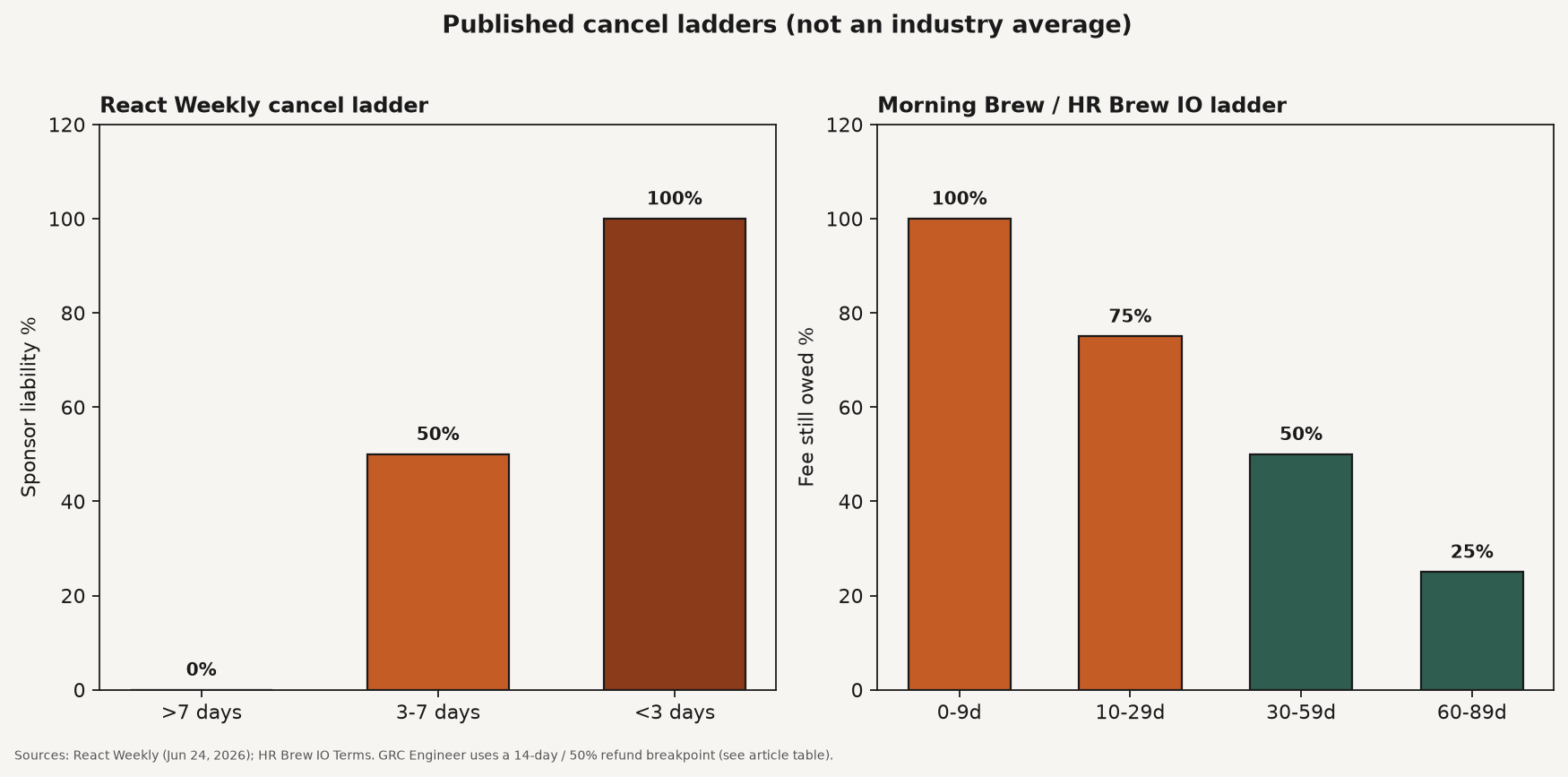
Source: React Weekly (https://react-weekly.dev/sponsor/terms); GRC Engineer (https://grcengineer.com/c/terms); HR Brew / Morning Brew IO (https://www.hr-brew.com/io-terms-conditions). Accessed 2026-09-27.
| Publisher (public terms) | Window / notice | Sponsor outcome (default) | Notes |
|---|---|---|---|
| React Weekly | More than 7 days before issue | Full refund or credit | Booking confirmed after payment in full unless other terms agreed (React Weekly, updated Jun 24, 2026) |
| React Weekly | 3 to 7 days | 50% refund | Mid window |
| React Weekly | Less than 3 days | No refund | Missed asset deadlines may be treated as sponsor-driven cancel |
| GRC Engineer | 14 or more days | 50% refund | Refunds processed within 14 business days (GRC Engineer, Feb 2026) |
| GRC Engineer | Less than 14 days | No refund | Publisher cancel with 14+ days notice means full refund to sponsor |
| Morning Brew / HR Brew IO | 0-9 days before Exposure Live Date | Advertiser pays 100% of fee | Applies to many Custom Materials; presenting sponsor, exclusivity, and branded content are strictly non-cancellable (HR Brew) |
| Morning Brew / HR Brew IO | 10-29 days | 75% of fee | Stepped fee |
| Morning Brew / HR Brew IO | 30-59 days | 50% of fee | Stepped fee |
| Morning Brew / HR Brew IO | 60-89 days | 25% of fee | 90+ days: inventory moves without cancel fee; pricing adjustments may apply |
Read each row as that publisher’s published policy, not as a universal law. There is no public dataset that averages these ladders into one “correct” percentage for every niche.
The IAB/4A’s Standard Terms for internet advertising (buys of one year or less) still shape agency expectations:
| Deliverable type | Without-cause cancel notice (no penalty) |
|---|---|
| Guaranteed (e.g. CPM) | 14 days |
| Non-guaranteed (e.g. CPC / CPA) | 7 days |
| Flat fee / fixed placement (roadblocks, some sponsorships) | 30 days |
Source: IAB/4A’s Standard Terms PDF, Section V.
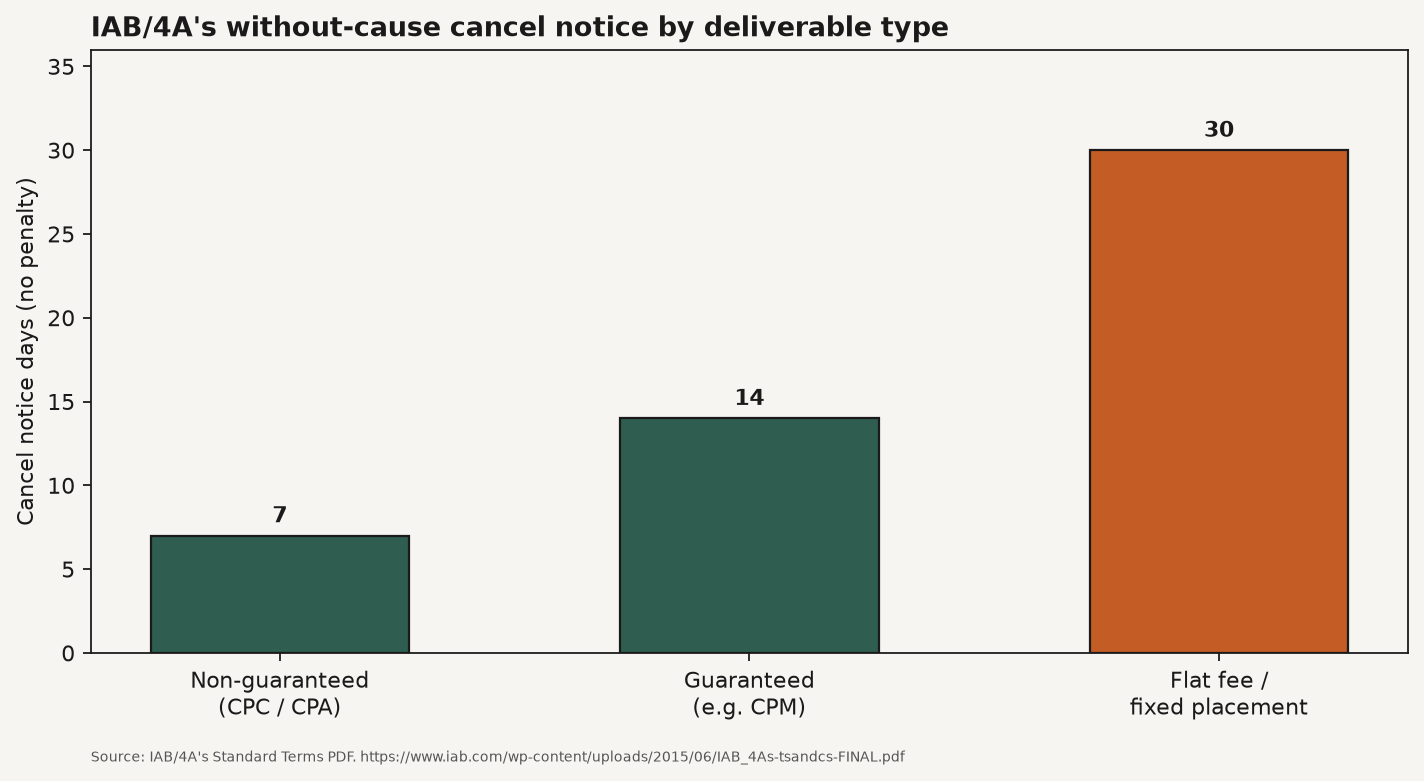
Source: IAB/4A’s Standard Terms for Internet Advertising for Media Buys One Year or Less. https://www.iab.com/wp-content/uploads/2015/06/IAB_4As-tsandcs-FINAL.pdf
Indie weeklies often run tighter than 30 days because inventory turns weekly. Agency buyers may still ask for IAB-like notice. Name your window in the IO so the conversation is about your published ladder, not a remembered blog post.
React Weekly and GRC Engineer speak in refunds of fees already paid. Morning Brew’s IO speaks in fees still owed on cancel. Both are kill economics. Prepaid full invoices make refund ladders natural. Net-30 after send makes “remaining fee due” language natural. InfluencersKit’s deposit guidance (50% upfront for new advertisers) reduces chase risk either way (InfluencersKit).
CrossLetter also flags the publisher-side cancel: early notice plus rebook, discount, or refund when you cannot deliver (CrossLetter). Reliability is a renewal metric. Put symmetric publisher-cancel language next to the sponsor kill ladder.
Do not copy a Morning Brew 89-day ladder onto a 5,000-subscriber weekly if you cannot enforce it. Do not invent a median. Publish the ladder you will actually collect on.
Writing a kill-fee policy is an ops document job, not a vibes negotiation. Pick breakpoints in days before send, state refund or remaining-fee language, name non-cancellable SKUs, and paste the ladder into every IO confirmation before you hold inventory.
These answers cover the kill-fee questions operators ask first: what the fee is, which published ladders exist, where the policy belongs, whether an industry average exists, and how deposits fit. This is planning language from public terms, not legal advice.
Q: What is a newsletter sponsorship kill fee? A: It is the money the advertiser still owes, or the refund share they forfeit, when they cancel after you held a dated sponsorship slot. It prices the inventory you stopped selling to other brands.
Q: What cancel windows do published newsletter terms use? A: React Weekly uses more than 7 days (full refund or credit), 3 to 7 days (50% refund), and under 3 days (no refund). GRC Engineer uses 14 days for a 50% refund and no refund under 14 days. Morning Brew’s HR Brew IO uses stepped 100% / 75% / 50% / 25% fees across longer day bands for many Custom Materials.
Q: Where should the kill fee live: media kit or insertion order? A: Publish the ladder where sponsors can read it (media kit or sponsorship terms page), then freeze the specific booking in the insertion order. The kit discloses. The IO binds one purchase.
Q: Is there an official average kill-fee percentage? A: No. There is no public dataset that publishes one official median kill-fee percentage across newsletters. Use named published ladders as reference, then write a policy you will enforce.
Q: Do I still need a deposit if I have a kill fee? A: A kill fee and a deposit solve different problems. The deposit reduces unpaid invoices. The kill fee prices late cancels on held inventory. InfluencersKit treats a 50% deposit as a normal ask for new advertisers. Many operators use both.
A newsletter sponsorship kill fee is opportunity-cost pricing for a slot you held and could not easily refill. Compare published ladders, pick breakpoints that match your send cadence, match refund language to how you invoice, and freeze the ladder in the IO. If you also want creators to sell a product you built, list it on feat..
Preference center best practices: CAN-SPAM menu plus stop-all, Google one-click vs body preference pages, and SendGrid's labeled 20% unsub drop.
Mailchimp vs Klaviyo: contact billing fork, send multipliers (10x/12x/15x), starting prices, and when ecommerce depth beats a general ESP.
Email list growth benchmarks: Omnisend 1.24B popup displays at 2.1%, form-type ladder, and levers that beat the average without inventing MoM %s.