Email Preference Center Best Practices
Preference center best practices: CAN-SPAM menu plus stop-all, Google one-click vs body preference pages, and SendGrid's labeled 20% unsub drop.
Replenishment email benchmarks: same-SKU reorder timing, labeled small-panel RPR $0.17-$0.29 medians, and why Omnisend cross-sell is not replenishment.

TL;DR: Replenishment email benchmarks measure same-SKU reorder reminders timed to consumption, not post-purchase cross-sell and not subscription charge notices. Omnisend has no replenishment row. Labeled small panels show median RPR near $0.17 to $0.29, with wide top tails. Time the SKU first. Refuse agency $5-$12 RPR mashups.
Founders paste “replenishment open rate” into a slide next to abandoned cart and wonder why finance does not believe either number. Consumable reorder is a different job. Grade it like a mini-cart and you will either skip the flow or buy a fake dollar band from an agency blog that never published a sample size.
The full cluster map lives in the email marketing guide.
Replenishment email benchmarks are planning numbers for automations that remind buyers to restock a product they already purchased, timed to how long that product lasts. Immediate post-purchase utility lives in post-purchase email benchmarks. High-intent recovery lives in abandoned cart email benchmarks and abandoned checkout email benchmarks. Broader ladders live in email marketing benchmarks by industry.
Replenishment email benchmarks are labeled performance ranges for automated messages that remind a past buyer to reorder a consumable product near the end of its use cycle, usually reported as click rate, conversion or placed-order rate, and revenue per recipient from a named sample that separates this job from cross-sell and winback.
They are not a synonym for post-purchase email benchmarks. Post-purchase covers receipts, shipping, feedback, and early next-order nurture. Replenishment is the later clock: same SKU, timed to empty. Klaviyo also separates replenishment from subscription charge notices. One asks the customer to buy again. The other tells them a card already ran or will run (Klaviyo).
If you sell bedding, furniture, or one-time gear, this page is mostly a fit test you will fail. Cross-sell or browse is the better sibling. If you sell coffee, supplements, pet food, skincare, or cleaning refills, this is the flow cart envy keeps starving.
Replenishment email benchmarks matter because consumable brands lose the second order to Amazon, a corner store, or a competitor ad the week the jar empties. Misread the metric and you either spam day three with a “buy more” coupon or never build the clock at all.
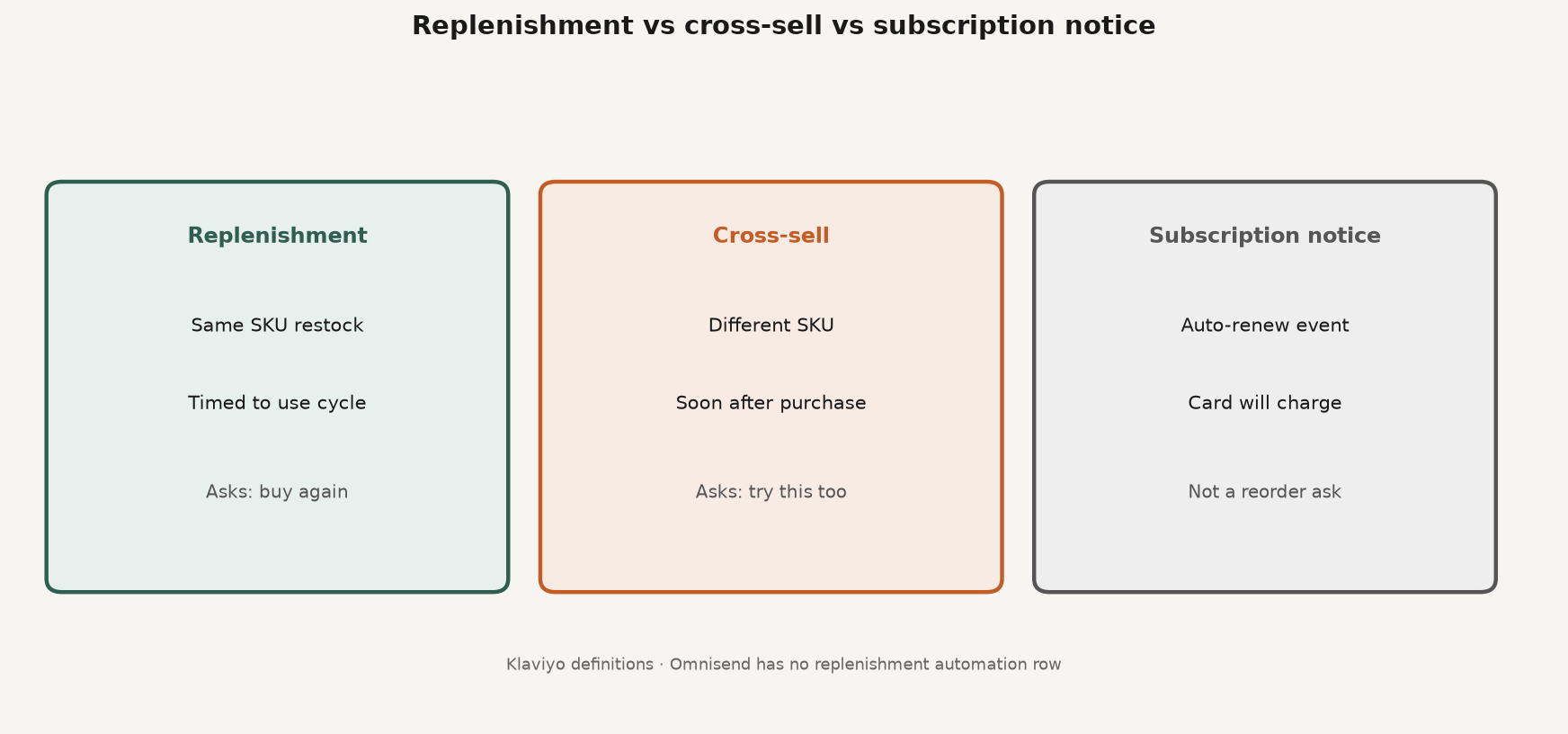
Source: Editorial framework synthesizing Klaviyo replenishment definitions and help-center trigger rules. https://www.klaviyo.com/blog/the-email-automation-all-consumable-goods-brands-need-that-many-dont-yet-use · https://help.klaviyo.com/hc/en-us/articles/360003195232
Replenishment email benchmarks work when you lock the job and the sample size before you lock a dollar target. Use Klaviyo for trigger grammar. Use Omnisend only for sibling automations that are not replenishment. Use small labeled panels for honesty. Use same-SKU operator data to decide whether the flow deserves a build.
| Job | What it asks | Typical trigger | Published planning figures |
|---|---|---|---|
| Replenishment | Reorder the same (or sized-up) consumable | Placed Order + product filter + delay to use cycle | Top Growth RPR $0.17 / $3.27 (n=4); BS&Co RPR $0.29 (n=5) |
| Post-purchase follow-up | Check-in, education, soft next step | Days after Placed Order | Omnisend Order follow-up $1.75 / 0.93% |
| Cross-sell | Buy a different SKU | Post-purchase or browse | Omnisend Cross-sell $0.95 / 0.87% |
| Abandoned cart / checkout | Finish an unfinished session | Added to Cart / Checkout Started | Omnisend cart $3.59; Top Growth cart $1.82 / checkout $2.57 |
| Subscription notice | Card will charge / order ships on auto-renew | Subscription platform events | Not a replenishment email (Klaviyo definition) |
Do not put Omnisend Cross-sell $0.95 into a “replenishment benchmark” cell. The labels disagree.
Across 7,454 repeat purchase journeys in 16 brands, one r/Klaviyo operator reported 77% same-product second purchases and 23% different-product second purchases, with a top consumable reorder rate of 91% (thread). Export your own second-order SKU mix before you fund a three-email accessory sequence. If same-SKU dominates, replenishment timing beats early cross-sell. Our post-purchase spoke already flags this. This page owns the reorder clock that follows.
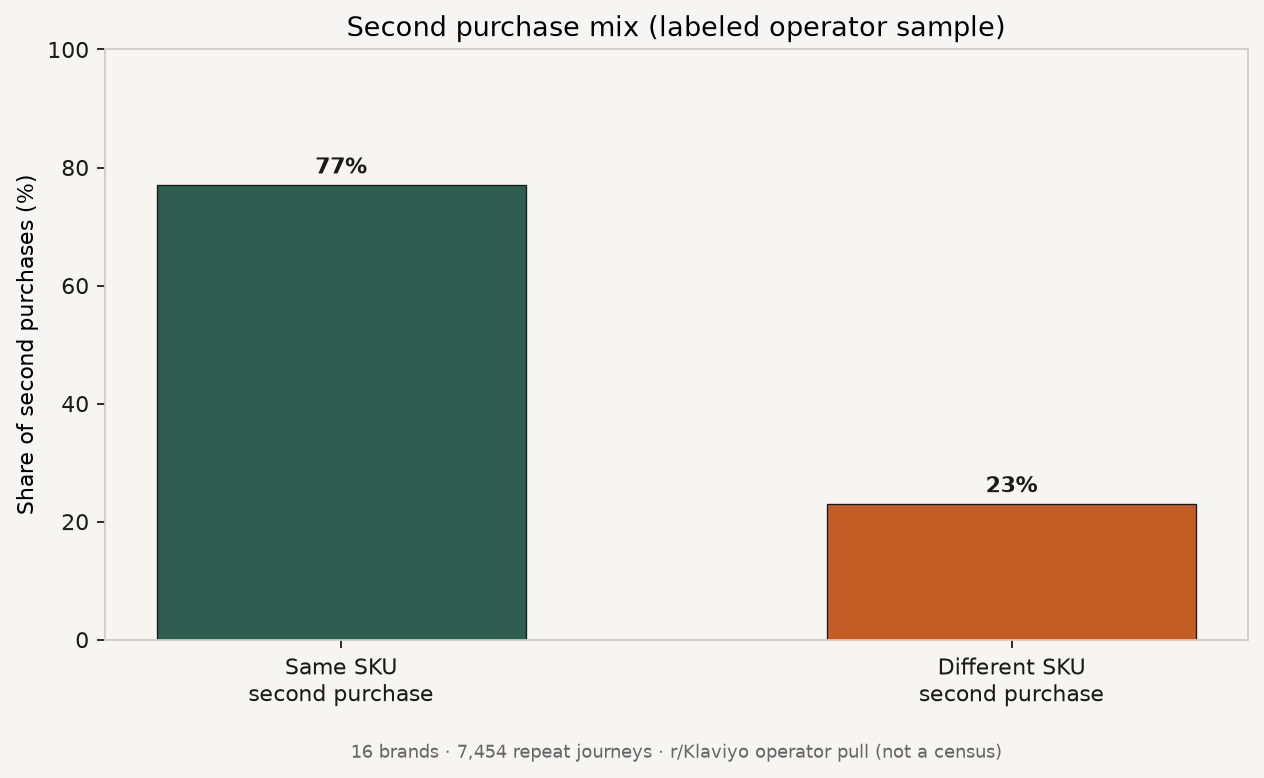
Source: Labeled r/Klaviyo operator sample (16 brands; 7,454 repeat journeys), not a multi-ESP census. https://www.reddit.com/r/Klaviyo/comments/1rdpvr6/pulled_secondpurchase_data_across_16_brands_and/
Top Growth analyzed first-party Klaviyo flows for 21 DTC brands (July 2025 to June 2026). Replenishment appears in 4 brands only. Median RPR is $0.17, top quartile $3.27, median conversion 0.19%, top-quartile conversion 1.66%, median click 1.52% (Top Growth). The publisher flags types with four to six brands as indicative. Treat it that way.
BS&Co published a 14-brand portfolio pull (trailing 365 days). Replenishment meets their floor in 5 brands. Full-flow median conversion is 0.49%, median RPR $0.29, with RPR ranging about $0.14 to $2.17. Entry-email median conversion is 0.46% (BS&Co). Agency-managed, small n, Klaviyo attribution. Still more honest than an unsourced $8 average.
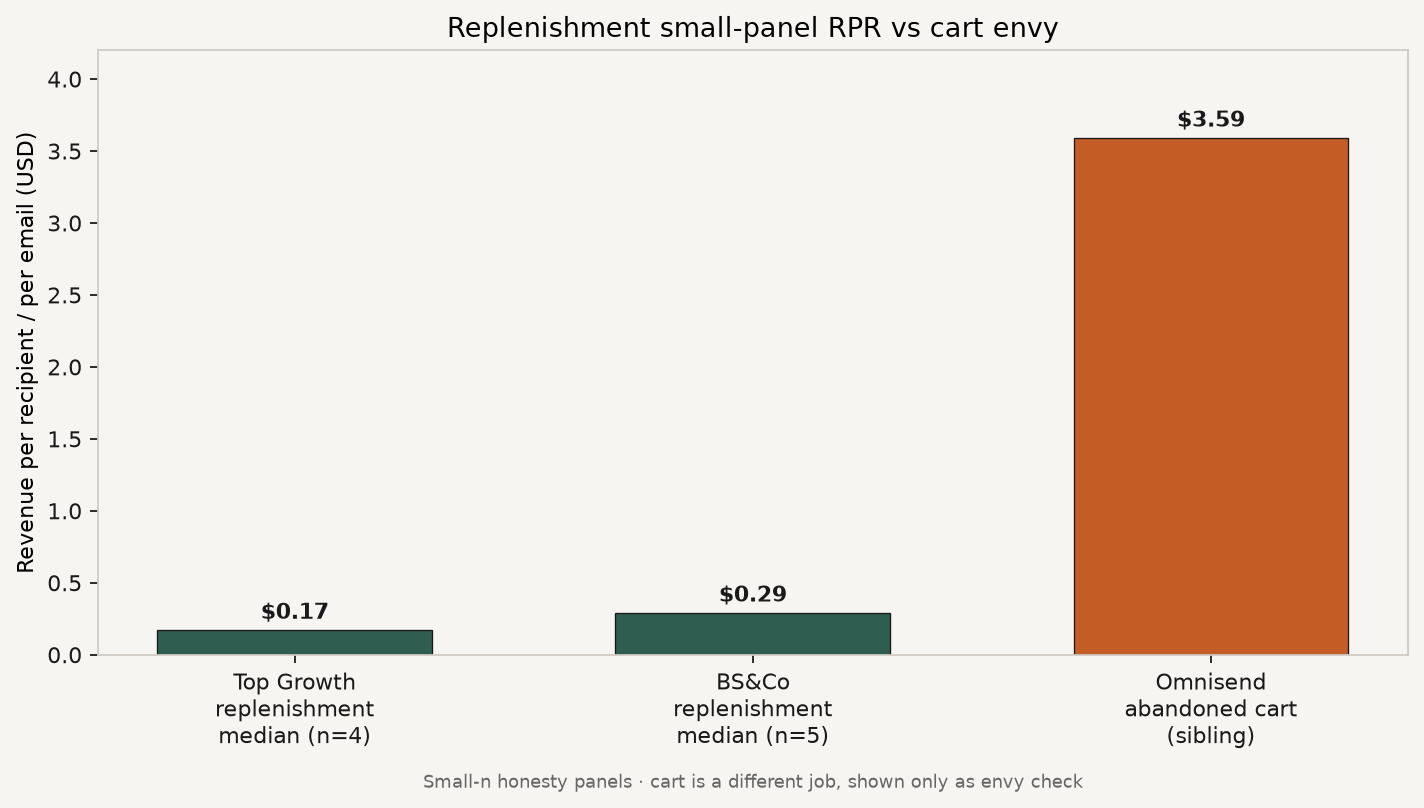
Source: Top Growth Marketing (n=4 replenishment brands) and BS&Co (n=5), with Omnisend Abandoned cart $3.59 as sibling envy check. https://topgrowthmarketing.com/dtc-ecommerce-benchmarks/email-flow-benchmarks/ · https://bsandco.us/blog-post/klaviyo-flow-benchmarks · https://www.omnisend.com/blog/email-marketing-benchmarks/
Top Growth’s replenishment top-quartile RPR ($3.27) sits near Omnisend cart dollars ($3.59) while the median stays at $0.17. That spread is the story. Consumable-heavy catalogs with tight delays can print. Mixed catalogs with wrong timing look dead. A single national average would lie in either direction. That is why this page refuses a fake mid-band.
Prefer click, conversion, and RPR. Apple Mail Privacy Protection can inflate opens, so treat open rate as directional (email marketing benchmarks by industry).
There is no public dataset for one official replenishment RPR and placed-order table across every Klaviyo or Omnisend account. Omnisend does not publish a replenishment automation row. Agency bands that invent $5-$12 RPR, 5%-15% conversion, or a single Listrak CTOR as a universal replenishment law stay out of the charts. feat. does not invent a proprietary reorder census here.
Using replenishment email benchmarks means proving consumable fit, measuring your own reorder interval, then building a short Placed Order flow that exits on repurchase. Score dollars against labeled small panels, not against cart envy or agency mashups that invent five to twelve dollar RPR bands without a sample size.
These answers restate the same-SKU job fork, the Omnisend proxy trap, and the small-panel honesty numbers so a founder can quote a labeled median without inventing a national replenishment RPR figure that no ESP has published for every consumable catalog.
Q: What are good replenishment email benchmarks in 2026? A: Use labeled small panels until a real ESP census exists. Top Growth shows replenishment median RPR $0.17 and top quartile $3.27 (n=4). BS&Co shows full-flow median RPR $0.29 and conversion 0.49% (n=5). Do not treat Omnisend Cross-sell $0.95 as a replenishment cell.
Q: What is a replenishment email flow? A: It is an automation that reminds a past buyer to restock a consumable near the end of the use cycle. Klaviyo triggers it from Placed Order, filters out people who already reordered, and separates it from subscription charge notices.
Q: How is replenishment different from cross-sell? A: Replenishment asks for the same SKU on a consumption clock. Cross-sell asks for a different SKU. Omnisend’s Cross-sell row earns $0.95 per email with 0.89% unsubscribe. A labeled operator pull found 77% of second purchases were the same product across 7,454 journeys in 16 brands.
Q: When should I send a reorder reminder email? A: Time it from supply length or average time between orders. Klaviyo’s help example uses about 25 days for a 30-day supply, with a blog band of 20-25 days so shipping can land before empty. Too early becomes spam. Too late loses the refill.
Q: Why are public replenishment RPR numbers so low compared with cart? A: Because many catalogs are not pure consumables, samples are tiny, and timing is often wrong. Top Growth’s median $0.17 and top quartile $3.27 show the spread. Cart recovers an unfinished session. Replenishment waits weeks. Different jobs.
Replenishment email benchmarks are a timing and taxonomy problem before they are a creative problem. Same SKU on a consumption clock. No Omnisend replenishment row to hide behind. Small labeled medians near $0.17 to $0.29, with a real top tail when the catalog fits.
If affiliates should sell the refill those buyers already proved they want, browse the feat. marketplace for co-branded storefront inventory.
Preference center best practices: CAN-SPAM menu plus stop-all, Google one-click vs body preference pages, and SendGrid's labeled 20% unsub drop.
Mailchimp vs Klaviyo: contact billing fork, send multipliers (10x/12x/15x), starting prices, and when ecommerce depth beats a general ESP.
Email list growth benchmarks: Omnisend 1.24B popup displays at 2.1%, form-type ladder, and levers that beat the average without inventing MoM %s.